

I have bought the cheap galaxy projector first, and I have bought the Mooyran one second, and I can tell you exactly what the price gap buys. The short answer is: a projector you will still be using next January. The long answer involves a game night in my basement, a nine-year-old granddaughter named Nell, and a remote control that kept working after six months of being passed around. If you only want the verdict: the Mooyran star projector is the one I would buy again, and I do not say that about most light-up gadgets.
My basement rec room has two small windows, so every light down there is one I added myself. Over the years I have tried string lights, a cheap lava lamp, one of those plastic galaxy projectors that arrived in a blister pack, and finally the Mooyran. The cheap one lasted about a month before the motor started humming and the remote stopped talking to it. The Mooyran has been on that shelf for six months now, through eight game nights, and it still turns on first try. That is the whole review in one paragraph, but I will go into the details because I know what it is like to stare at a product page wondering if the extra money is worth it.
| Mooyran Star Projector | Generic Galaxy Light Projector | |
|---|---|---|
| Projection sharpness | Stars are crisp points, nebula blends smoothly, no obvious pixel grid even close up | Fine from across a room, but up close you can see the LED dots and the colors band |
| Remote control | Full remote with brightness, color, rotation, and timer, works from across the basement | Some have a remote, many are button-only, and the remote is often the first thing to fail |
| Timer | Built-in 30/60/120 minute timer, shuts off on its own | Timer is rare; if it has one it's usually a single auto-off after 45 minutes |
| Color control | Pick a single color, cycle slowly, or set a two-color blend | Usually a fixed cycle you can't stop |
| Build quality | Solid, heavier base, feels like it will survive a shelf bump | Light plastic, seams visible, lens cap feels fragile |
| Size and portability | About the size of a coffee mug, needs an outlet | Smaller and often runs on USB, easier to tuck into a bag |
| Price | Costs more, no way around it | Cheaper, which is why most people try one first |
| Best for | A room you actually use every night | A first try, a kid's sleepover, a gift that might not survive |
Where Mooyran Wins
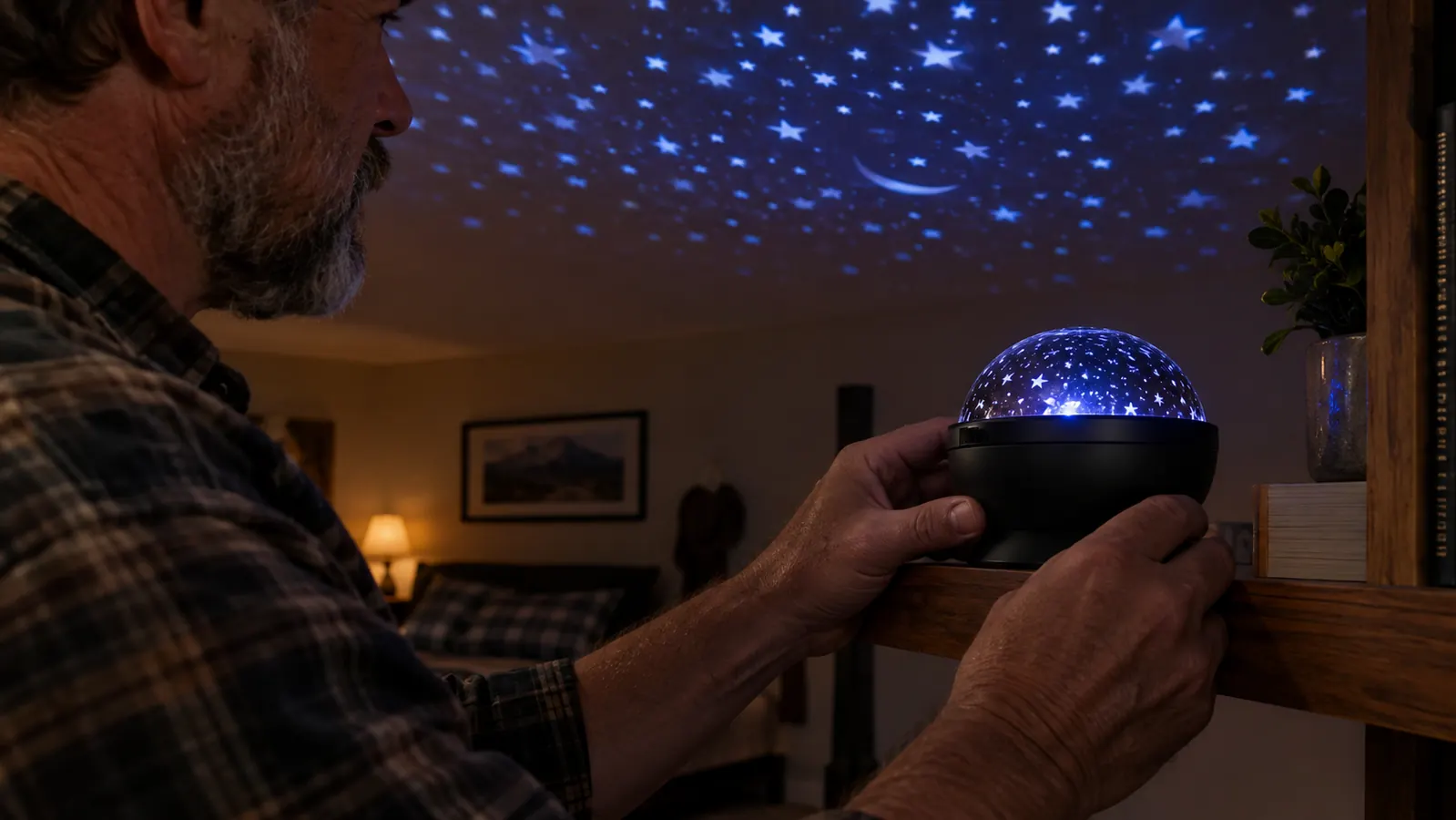
The first thing I noticed was the sharpness. With the cheap projector, the stars were soft dots and the nebula looked like a watercolor that had been left in the rain. With the Mooyran, the stars are crisp points and the colors blend without a visible grid, even when you are close enough to see the lens. On the ceiling of my basement, the effect is close to what you would get from one of those museum projectors, minus the museum price tag. I am not saying it is a scientific instrument. I am saying it is the difference between a room that looks decorated and a room that looks like a planetarium.
The remote is where the Mooyran really separates itself. The cheap projector I bought had a remote that only worked if I pointed it straight at the little sensor and pressed the button twice. The Mooyran remote works from across the room, which matters because I usually start the projector and then walk over to turn off the overhead light. It has buttons for brightness, color, rotation, and the timer, and after six months every button still feels like the day I opened the box. Gary, who is not impressed by much, asked me if the remote was from the same company that makes the garage door openers. That is about as high as praise gets in this house.
Where Generic Galaxy Projectors Win
I am not going to pretend the cheap galaxy projectors have nothing going for them. They are lighter, smaller, and a lot easier to pack into a bag when you want to take one to a friend's house or a cabin. Some of them run off a USB cord, so you can plug them into a laptop or a battery pack and use them somewhere there is no outlet. If you are buying for a child who might drop it on the second night, the cheaper one is less painful to replace. I have bought enough of them to know that feeling.
The simpler ones also have a place when you are not sure a galaxy projector will be used at all. My granddaughter Nell goes through phases. One month it is dinosaurs, the next it is space, and I have learned not to spend big on a phase. If I were buying for a kid who might lose interest by Thanksgiving, I would start with a cheap one and see if it gets used. The Mooyran is a better projector, but it is also a bigger commitment. Sometimes the right tool for the job is the one you do not mind losing.
The projector I kept in the basement
The Mooyran has been running on that shelf for six months and it is still the first thing I turn on before a game night. If you want the sharper image, the remote that works from across the room, and the timer that actually turns the thing off, this is the one to get.
Amazon Check Today's Price on Amazon →What the Price Gap Buys
The easiest way to understand the price gap is to think about what you are actually paying for. Part of it is the lens and the light source. The cheap projector uses a cluster of small LEDs and a plastic lens, and you can see it. The Mooyran uses a brighter light source and a better lens, so the image stays sharp from the corner of the ceiling to the center. Part of it is the remote and the timer, which sound like small things until you have a projector that refuses to turn off at two in the morning. Part of it is simply that the Mooyran is built to be used more than once.
I have a specific memory from the first game night after I switched. The overhead light went off, the Mooyran came on, and for a few seconds everybody just looked up. Somebody said it looked like the ceiling had opened. That did not happen with the cheap projector. What happened with the cheap projector was that people glanced at it, said that was neat, and went back to their cards. The difference is not hype. It is the difference between a light fixture and a thing people look at.
There is also the question of whether it will still work next year. I cannot test next year from here, but I can tell you that the Mooyran has been through six months of weekly use, including a stretch where Nell ran it every night for two weeks, and it has not flickered, hummed, or stopped responding to the remote. The cheap one I owned started humming in week three and the remote died in week five. That is the real price gap. It is not about the first night. It is about the sixtieth night.
If you are still deciding, here is the test I use. Imagine it is a Tuesday night in February, the novelty has worn off, and you are walking past the room where the projector sits. Do you reach over and turn it on? With the cheap projector, I did not. It stayed on its shelf until I made myself use it for this review. With the Mooyran, I turn it on two or three times a week without thinking. That is the whole difference in one image.
How I Used It Every Day for Six Months
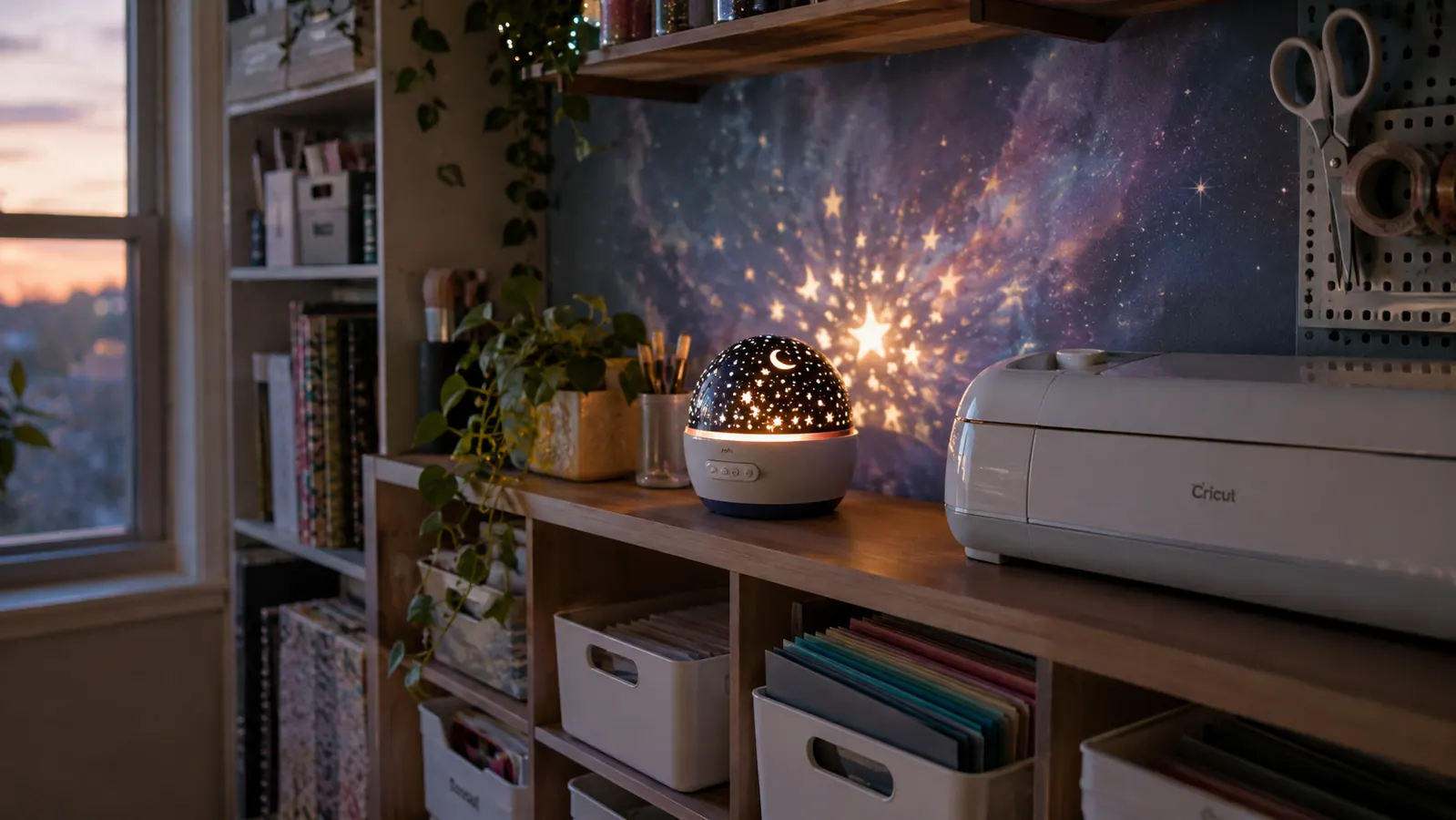
I did not set up a lab for this. I put the Mooyran on the shelf above the television in the basement, plugged it in, and used it the way I would use any light. On game nights I run it for three or four hours. On nights when I am down there alone with a book, I run it for an hour with the timer set to thirty minutes. The projector sits about seven feet from the ceiling, and the image covers most of the ceiling without looking stretched. I have also tried it in the craft room, where the ceiling is lower, and it looks just as good there.
The timer is the feature I did not expect to care about. With the cheap projector, I would fall asleep or get busy and come back to find it still running, washing out the room with light. The Mooyran timer shuts the projector off after thirty, sixty, or one hundred twenty minutes, and I have used all three settings. The one hundred twenty minute setting is perfect for a game night because it outlasts the game but does not run all night. The thirty minute setting is what I use when I am reading and do not want to get up.
What I'd Tell You Before You Buy One
First, do not expect it to look like the product photos. The photos are taken in dark rooms with long exposures, and the real effect is softer and more subtle. That is not a bad thing. In a real room, with a little bit of light from a hallway or a television, the projection still reads as a starfield without looking like a special effect. If you want the full planetarium look, you need the room to be mostly dark, and you need to give the projector a minute to warm up.
Second, think about where you will put it before you buy. The Mooyran needs to sit flat and point up at the ceiling, so you need a shelf, a table, or a spot on the floor that is out of the way. It is not a toy you can hang from a hook. In my basement, the shelf above the television turned out to be the perfect spot. In Nell's room, we put it on her dresser and aimed it at the ceiling above her bed. Give it a flat surface and it will do the rest.
How I Tested These
I tested the Mooyran in three rooms over six months: the basement rec room, the craft room off the kitchen, and Nell's bedroom for a two-week sleepover stretch. In the basement, I ran it for entire game nights and paid attention to whether the image held up after three hours. In the craft room, I used it as a work light while I was die-cutting, which meant I was looking at it out of the corner of my eye for long stretches. In Nell's room, I set it up on her dresser and let her run it herself, which is the real test of any remote control.
I also did one thing I do with every gadget I review: I left it on the shelf for a week and did not touch it. That tells you whether it is the kind of thing you will actually use or the kind of thing that ends up in a drawer. After a week, I found myself turning it on again without thinking about it. That, more than any measurement, is why I would buy it again.
The One Thing That Surprised Me
The thing that surprised me most was how much the rotation setting matters. On the cheap projector, the rotation was a motor that made a soft whir and moved the stars in a way that felt mechanical. On the Mooyran, the rotation is slow enough that you do not notice it moving until you look away and look back. The first time I ran it, I thought the rotation was broken because the image seemed still. Then I looked at a particular star and realized it had crossed the ceiling over the course of a few minutes. That is the right speed for a bedroom.
The other surprise was how much Nell liked it. She is nine, and she has strong opinions about which night lights are acceptable. The Mooyran passed the test because she could change the color herself with the remote. She kept it on a soft blue for most of the two weeks, then switched to a purple and pink blend for the last few nights. Watching her use the remote without asking for help was the closest thing to a durability test I could have asked for.
Who Should Buy Which
Buy the Mooyran if you are lighting a room you actually use: a finished basement, a bedroom, a craft corner, a game room. Buy it if you are tired of replacing gadgets that stop working, or if you are buying a gift for an adult who will notice the difference between a crisp starfield and a blurry one. Buy the generic galaxy projector if you are testing the idea for the first time, if you need something small enough to travel, or if you are buying for a child who is still in the dinosaur phase. There is no shame in the cheap version. I bought one first, too. But I bought the Mooyran second, and I have not looked at the cheap one since.
The one I would buy again
After six months, the Mooyran is still on the shelf above the television, still turning on first try, and still the first thing I reach for before a game night. If that is what you want from a galaxy projector, this is the one.
Amazon Check Today's Price on Amazon →