
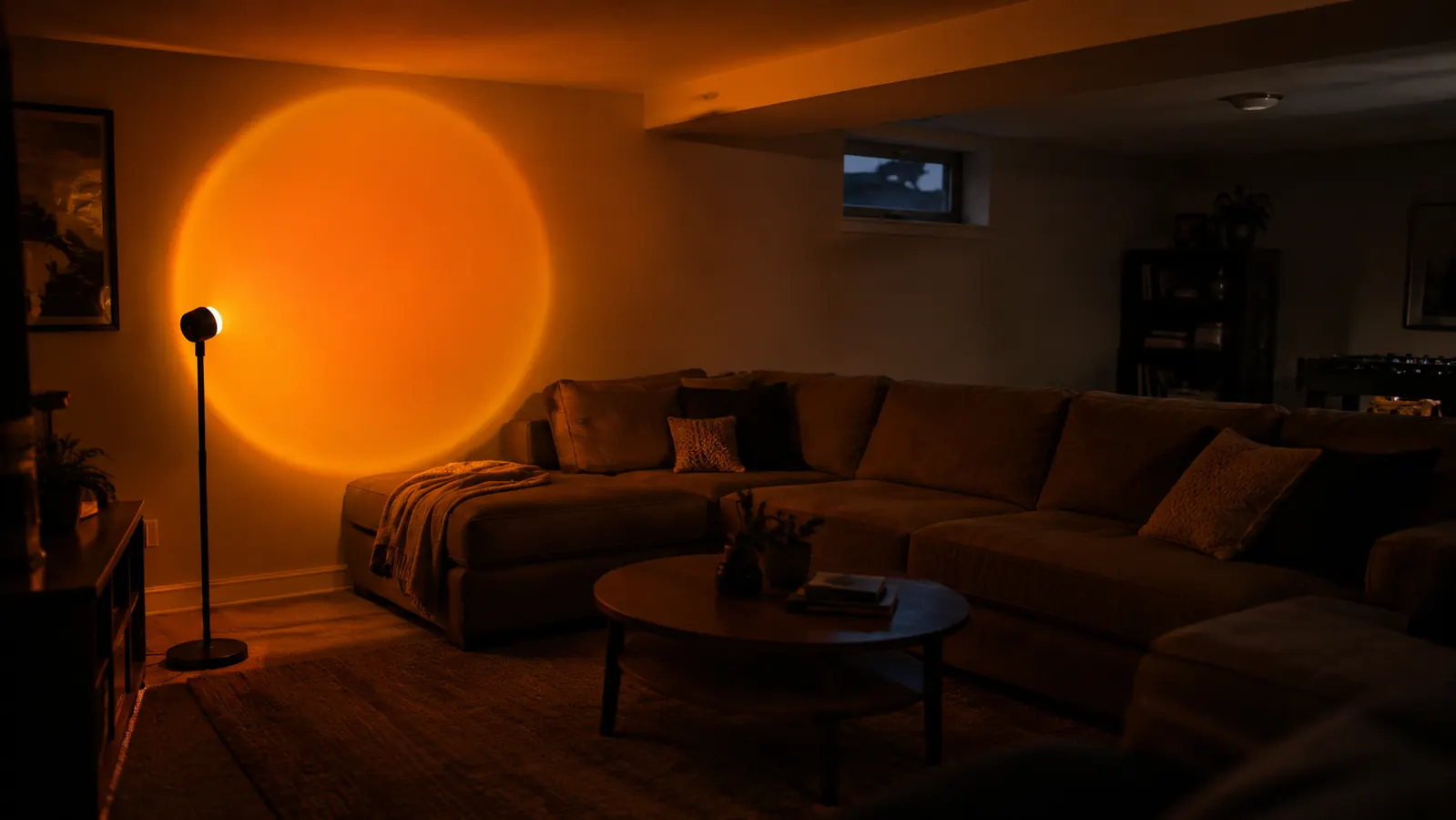
The Balkwan sunset lamp and the Tsrarey sunset lamp do the same trick. Both throw a warm orange ring onto a wall and turn a room into late evening in about two seconds. I bought the Balkwan first, back in February, because my basement has exactly two small windows and I wanted something on the wall behind the sectional that was not another table lamp. The Tsrarey came in April, when my granddaughter Nell decided she wanted one for her room and I wanted to know whether the cheaper-looking one was actually worse in any way that mattered. Both have been running most evenings since. The honest answer is that the difference between them has almost nothing to do with the light and almost everything to do with the stand, the cord, and where in a room you are physically able to put the thing.
That sounds like a dodge, so let me be specific about it. A sunset lamp is a small projector with a colored lens. The quality of the halo depends on distance to the wall, the angle you can hit it from, and whether the wall is flat and light colored. Every one of those is a mounting problem. So a lamp that can sit at the right height and point at the right angle beats a slightly better lens that has to live on the floor pointing up at a bookshelf. That is the whole review in one paragraph, and the rest of this is me showing my work.
| Balkwan Sunset Lamp | Tsrarey Sunset Lamp | |
|---|---|---|
| Placement | Comes with a floor stand, so the head can sit at wall height without furniture | Table and desk unit, needs a surface at the right height |
| Aiming | Head tilts on the stand and the whole stand rotates, so fine aiming is easy | Head rotates on its base, but the base height is fixed by whatever it sits on |
| Halo size at six feet | Roughly a four foot circle, soft edged | Similar circle, marginally tighter edge |
| Color | Rainbow rotation plus a warm sunset orange that most people leave it on | Fixed warm orange on most units, fewer choices |
| Power | USB cable, runs off a wall brick or a power strip | USB cable, same arrangement |
| Cord length | Long enough to reach a baseboard outlet from a stand | Short, which is a real constraint on a table |
| Heat after three hours | Warm to the touch on the housing, never hot | Warm to the touch on the housing, never hot |
| Price | Under twenty for the lamp and stand together | Usually a little less, sometimes noticeably less |
| Best for | A room where nothing is at the right height to set a lamp on | A desk, a nightstand, a shelf that already faces the wall |
What a sunset lamp actually does in a room
Neither of these is a light source. That is the first thing to get straight, because the product photos make both of them look like they are lighting the whole room and they are not. With the overhead off, the Balkwan puts a warm circle on the wall and leaves the rest of the basement dark enough that you would not read a magazine in it. The Tsrarey behaves the same way in Nell's bedroom. What you get is a glow on one wall and a general warm cast off the bounce, which is genuinely lovely and is not illumination.
The effect also depends on the wall more than either box admits. My basement walls are a flat off white and the halo lands beautifully. The back deck has cedar siding, and when I tried the Balkwan out there on a summer evening the halo went muddy and striped, because the wood grain broke it up and the color of the wood ate the orange. Nell's bedroom walls are a pale lavender, and the sunset reads a little pink on them, which she likes and I would not have predicted. If your walls are dark, textured, or strongly colored, neither of these lamps is going to do what the listing photo does.
Distance is the other half. Both lamps make a bigger, softer, dimmer circle the further back they sit, and a smaller, sharper, brighter one up close. Around five to seven feet is the range where both look their best in an ordinary room. Under three feet you get a bright little disc with a hard edge that looks like a flashlight. Past ten feet the halo goes so faint that turning it on barely registers.
The stand is the real difference
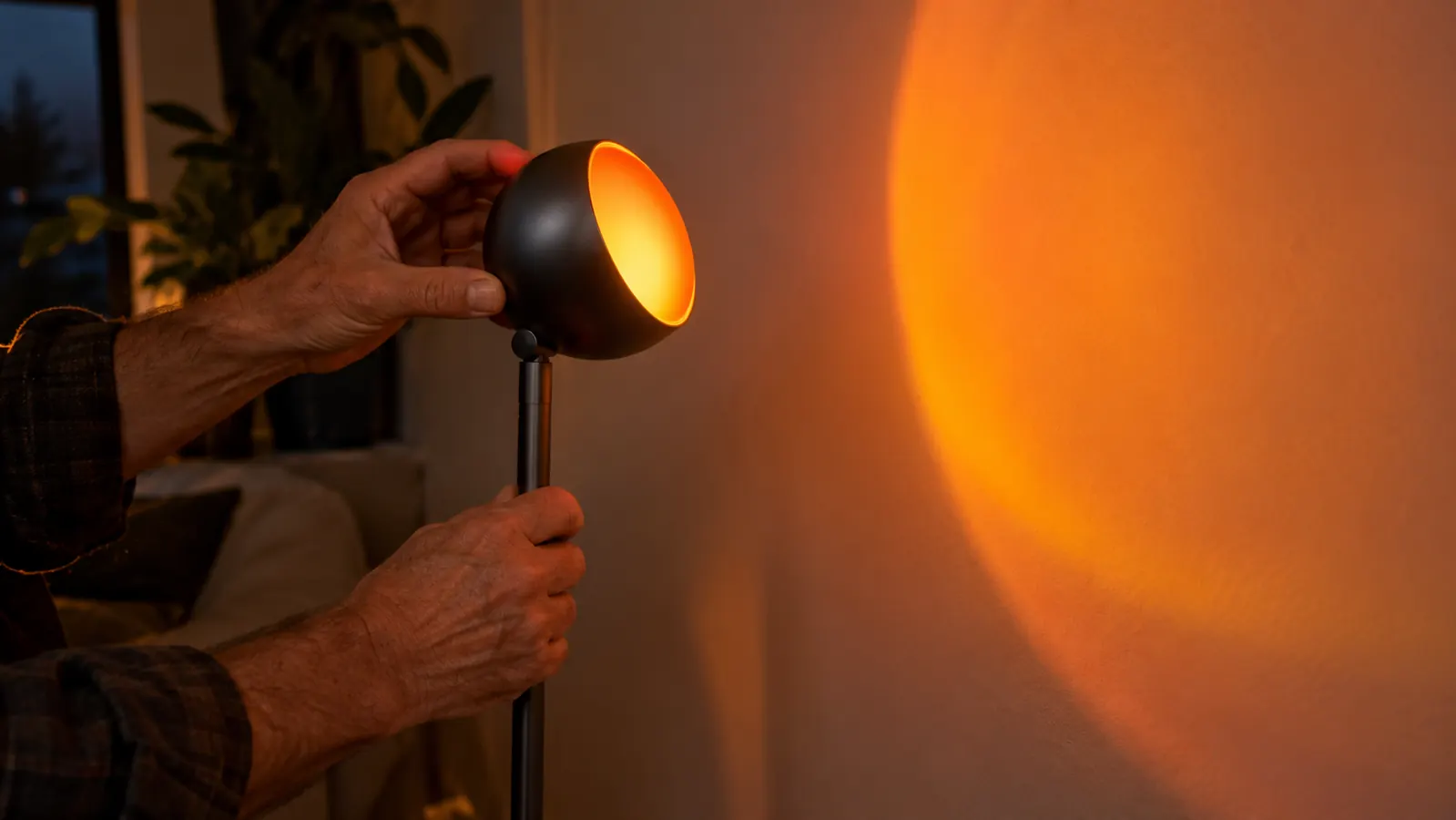
This is the thing I did not expect to be the headline, and it is. The Balkwan ships with a floor stand that puts the projector head somewhere around waist to chest height, depending on how you set it, and the head tilts. That means the light can strike the wall straight on from a spot where no table exists. In my basement the stretch of wall I wanted lit is behind the sectional, where there is no surface at all, and without the stand there would have been nowhere to put a lamp except the floor, aiming up, which produces an oval smeared toward the ceiling instead of a circle.
The Tsrarey is a table unit. The head swivels nicely, and if you already have a desk, a nightstand, or a shelf that faces the wall you want lit, that is completely fine and arguably tidier. Nell's dresser sits four feet from her wall and the Tsrarey lives on it and looks correct. But it can only ever be as well aimed as the furniture allows. In a room with the wrong furniture, that is not a small limitation, it is the entire outcome.
The cord follows from the same problem. The Balkwan cable is long enough that a stand sitting a few feet out from the wall still reaches a baseboard outlet, which is the only reason the stand is usable. The Tsrarey cord is noticeably shorter. On Nell's dresser it was fine because there is an outlet right behind it. On my basement shelf it would have needed an extension, and an extension running across a walkway is not something I am willing to do for a decorative light.
Color, and the part nobody mentions
Both lamps advertise color modes. The Balkwan does a slow rainbow rotation as well as the plain sunset orange. I have used the rainbow mode maybe four times total, all of them in the first week, and every visitor who has seen it has said something polite and then asked me to put it back on orange. The Tsrarey mostly just does the orange, and after eight months I think the simpler product understood its customer better than I did when I was comparing feature lists.
What nobody mentions is that the halo has a bright core and a dimmer ring, and how obvious that is depends on the lens more than the price. Up close, both show it. At a sensible distance, both soften out. If you are buying one of these to photograph things in front of, which a lot of people are, that core matters, because it will be the hot spot in your shot. I get around it by aiming slightly off so the subject sits in the outer ring rather than the middle. That trick works identically on both lamps and I wish somebody had told me in February. I wrote more about that setup in my notes on using a sunset lamp for photos and video.
Where each one actually ended up living
The Balkwan is on its stand behind the sectional in the basement, about six feet from the wall, and it goes on every first Saturday when the game night people come over. Eight or ten adults around a table, overhead light off, that one warm circle on the wall behind them. It does more for the look of that room than anything else I have bought for it, and I have bought a lot of things for it. It also gets switched on most ordinary evenings when it is just Gary and me down there with the television.
The Tsrarey is on Nell's dresser and she turns it on herself, which at nine years old is the whole point. It has survived being knocked over at least twice that I know about. Neither of these things is fragile, for what that is worth, though I would not make a habit of testing it.
The one with the stand is the one that goes anywhere
If the wall you want lit does not have a table in front of it, the Balkwan's floor stand is the reason to pick it. That is the difference that decided it in my basement, and it costs less than most people expect.
Amazon Check Today's Price on Amazon →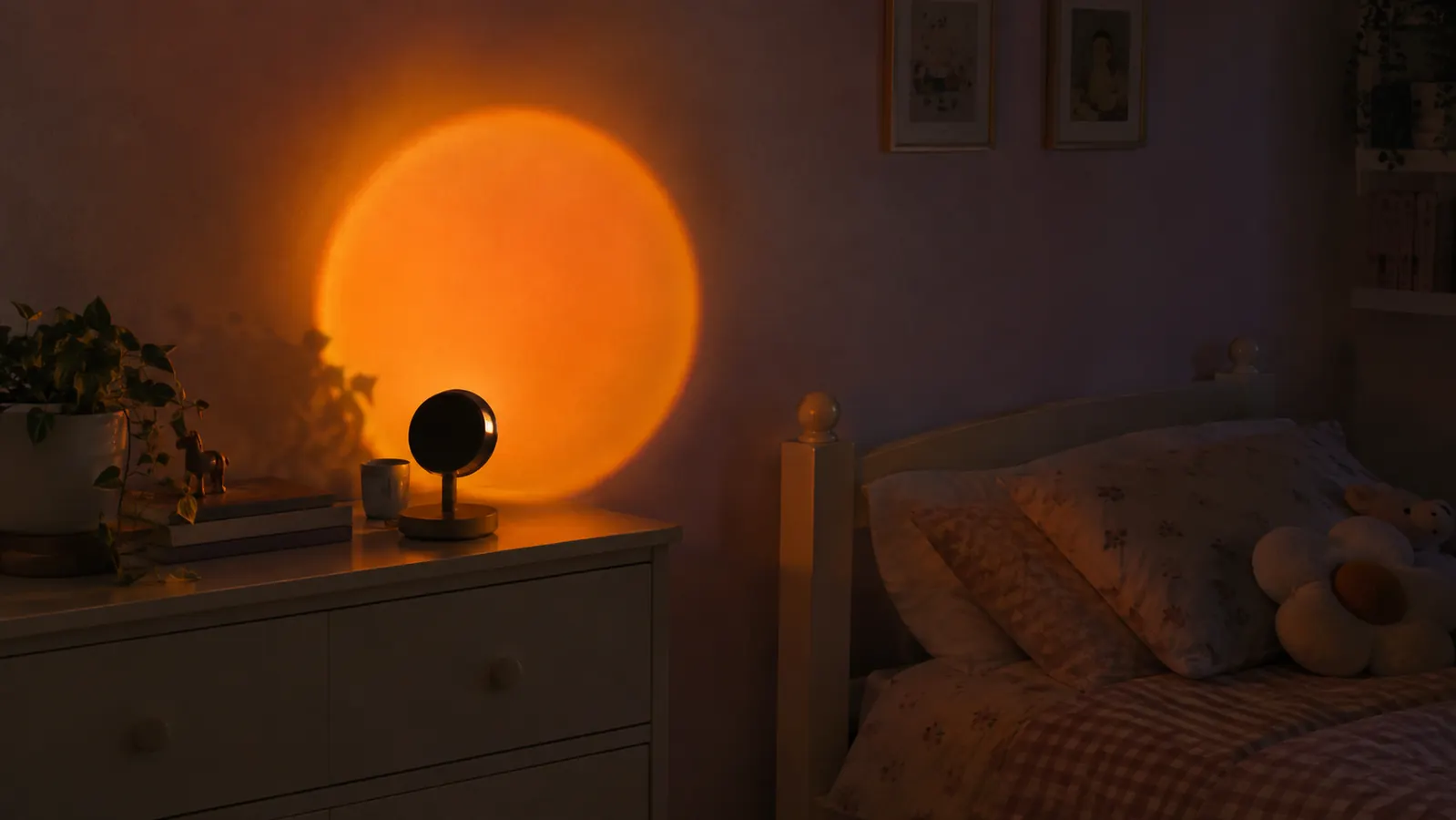
What has gone wrong with each of them
The Balkwan stand is the weak point of the Balkwan. The sections twist to lock and one of mine works loose over a few weeks, so every month or so the head has drooped a couple of inches and the halo has crept up the wall. It takes five seconds to fix and it is still annoying. If I were being hard on it I would say the stand is the reason to buy the lamp and also the cheapest-feeling part of it.
The Tsrarey's weak point is the cord, which I have already said, and the fact that its base is light enough to go over if something bumps the dresser. Neither unit has had an electrical problem, neither has flickered, and neither has gotten hot enough to worry me after three or four hours of running, which was the thing I was actually watching for. Both use a plain USB cable into a wall brick, so if the supply ever does fail it is a replaceable part rather than a dead lamp.
One genuine caution on both. These are decorative, they run for hours, and they are cheap, which is exactly the combination that leads people to leave them plugged into a daisy chain of adapters behind a couch. Give either of them its own outlet and do not run the cable under a rug.
Two things you only find out after a week
The first is noise. The rainbow rotation on the Balkwan is driven by a small motor, and in a quiet room you can hear it. It is not loud, it is a faint whir at maybe the level of a laptop fan, and in the basement with people talking or the television on it is completely inaudible. In a silent bedroom at eleven at night it would not be. On plain sunset mode nothing rotates and there is no sound at all, which is one more reason the orange setting has won by default. The Tsrarey on Nell's dresser makes no noise I have ever noticed, and for a room somebody sleeps in that is worth knowing before you buy rather than after.
The second is that neither of these dims in any useful way. Both have their brightness and that is what you get. In a fully dark basement the Balkwan is, if anything, slightly too strong at five feet, and my fix was to move the stand back rather than turn anything down, because there is nothing to turn down. If you are the sort of person who wants a dial, neither of these is that product, and the ones that do offer real dimming cost several times as much. Distance is the dimmer. Once I accepted that, placing both lamps got a lot easier.
Assembly is worth one line. The Balkwan stand comes in sections that screw together and took about three minutes with no tools. The Tsrarey comes assembled, because there is nothing to assemble. Neither one shipped with instructions worth reading, and neither one needed them.
Who should buy which
Buy the Balkwan if the wall you want to light does not have a surface in front of it at the right height. That is the case in most living rooms, most basements, and behind most sofas, and it is the situation the stand solves. Buy it also if you want the rainbow mode, though be honest with yourself about whether you will use it.
Buy the Tsrarey if you already have a desk, nightstand, or shelf facing the wall, if the outlet is close, and if you would rather spend less. In that specific arrangement it does the same job for less money and takes up less room. For a child's bedroom, where there is always a dresser and never a spare three feet of floor, I would pick it again.
What I would not do is agonize over the projection quality between them, because after eight months of looking at both almost every evening I cannot reliably tell which is which from across a room. The lens difference is real and it is smaller than the difference your wall color makes. Sort out where the lamp can physically sit first, and let that choose for you. If you want the longer version of how the Balkwan has held up on its own, I kept notes in my long term Balkwan review, and there is a broader list of what these lamps are good for in ten reasons a sunset lamp upgrades photos.
Eight months in, still on most evenings
The Balkwan has earned its spot behind the sectional and it is the one I point people at when they ask which sunset lamp to get. If the stand is what your room needs, it is worth a look.
Amazon Check Today's Price on Amazon →