
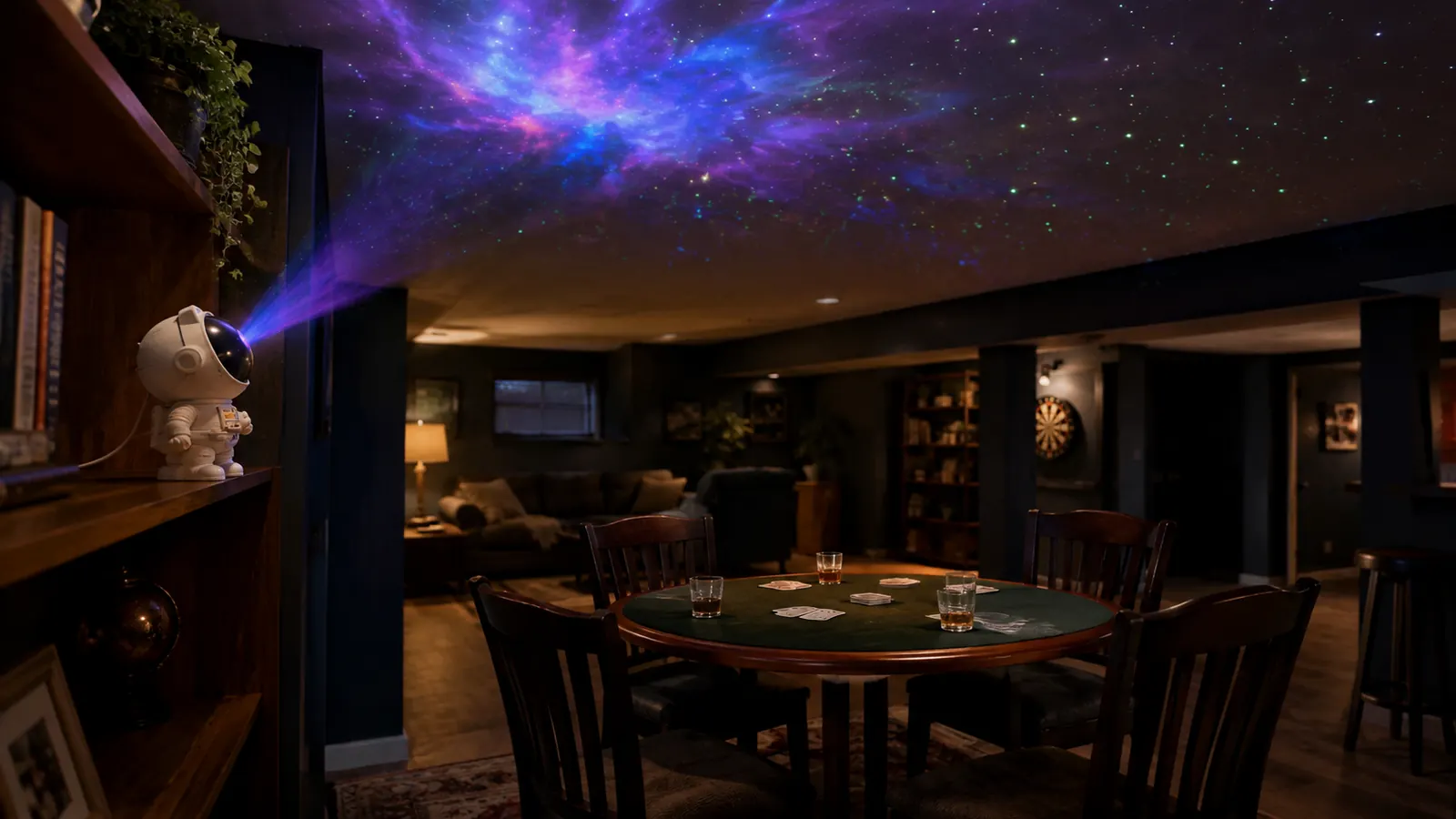
The first time I turned the Mooyran star projector on, down in the finished basement, I laughed. Not at it. At us. Here we were, ten of us getting ready for game night, and a small plastic astronaut on the bookshelf had everyone quiet for a solid minute, looking up at the ceiling. That is the honest power of this thing, and I want to lead with it, because most of what gets written about galaxy projectors is either breathless hype or pure dismissal. It is a toy, sure. It is also the easiest way I have found to make a room feel like an event without hanging a single thing from the ceiling.
Some background, so you know who is talking. I am fifty-eight, I live in a 1972 split-level in Cedar Rapids, and my basement rec room has exactly two small windows, both at ground level and both mostly behind the lilac bushes. Every usable light in that room is one I added myself over twenty-one years, so I have opinions about lights. I have bought the cheap version first, more than once, and I have sent more than one disappointed object back. The Mooyran astronaut is my third attempt at a star ceiling. I have been running it for six months now, through game nights, through a week of the grandkid convinced she needed to fall asleep under a real night sky, and through the October trick-or-treat walk when I did the lights for the whole block. This is the honest review I would have wanted before I ordered it.
The Quick Verdict
A charming novelty that does exactly what the listing promises, as long as you want a mood light for a dark room rather than a serious lighting tool.
Amazon Check Today's Price →The short version: buy it for the wow moment, not for the science.
Six months in, the Mooyran astronaut gets the same reaction it got on day one. Dark room, ceiling projection, game night. That is what it is for.
Amazon Check Today's Price on Amazon →How I've Used It
In six months the projector has been switched on maybe forty or fifty times, and it has settled into three recurring jobs. The main one is game night. First Saturday of the month, eight to ten of us in the basement, and once the cards come out the room goes half dark. That is when the astronaut earns its place. The ceiling projection runs the whole evening, and it is bright enough that nobody has to squint at their hand, but soft enough that it does not put a light in anyone's eyes. I have tried table lamps and a dimmer switch in that room over the years. This is the only lighting decision nobody has complained about.
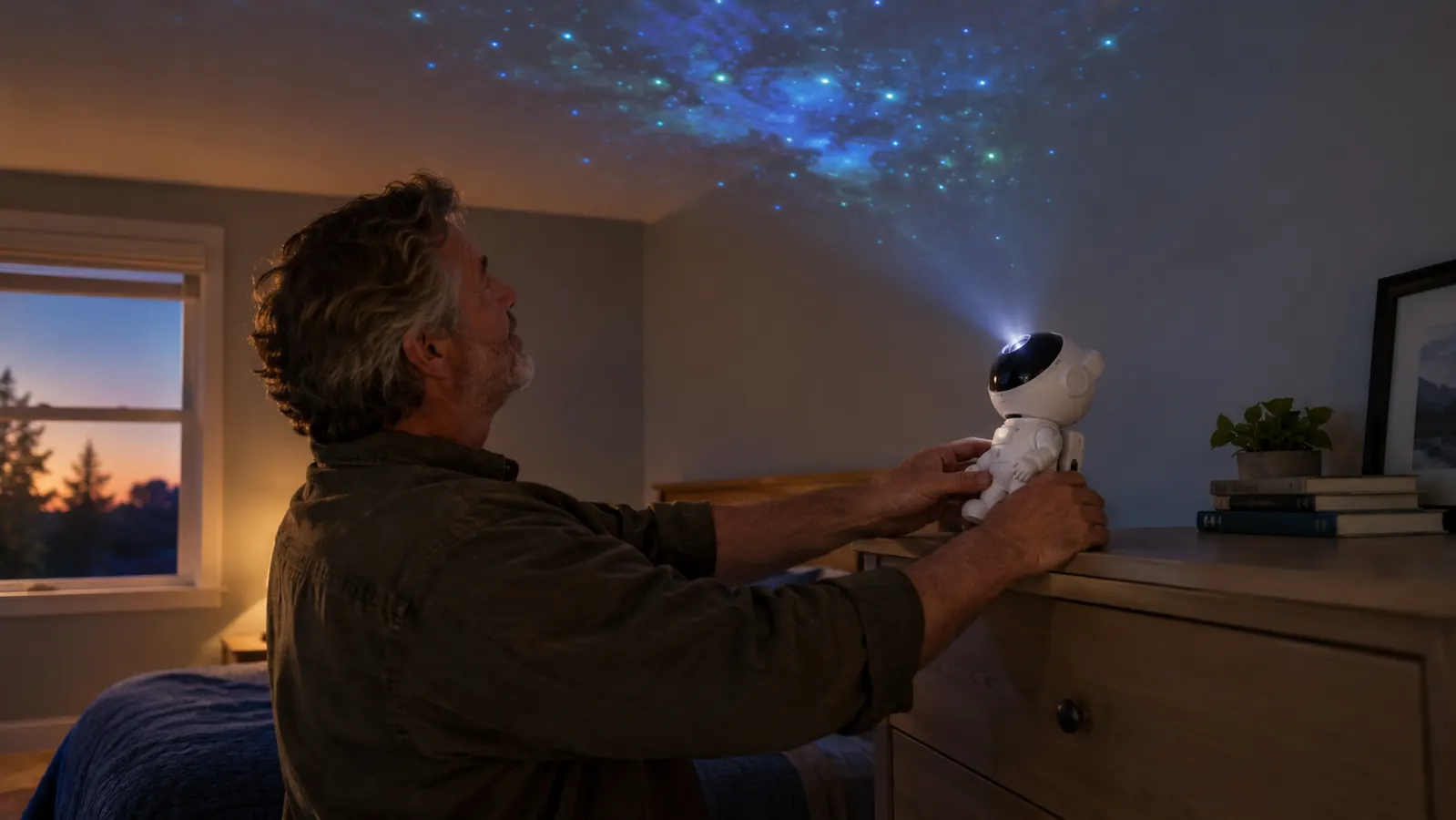
The second job is Nell. She is nine, and for about a week in March she was convinced she needed to fall asleep under a real night sky. The projector sat on her dresser, aimed at the ceiling, on the rotating mode, and she treated it like a major event. It ran on the two-hour timer every single night for that stretch, and the timer worked every single time. That matters more than it sounds like. You set it, you forget it, and you do not have to creep back in at ten-forty to switch the thing off. I have had other gadgets with timers that drifted or gave up. This one has not.
The third job is the one I did not plan for. In October I do the lights for the block's trick-or-treat walk, and this year the astronaut came out to the covered back deck for one night. It projected onto the ceiling of the porch and the wall above the door, alongside the string lights and the paper bats, and several parents asked what it was. The projector has also spent a few late nights in my craft room off the kitchen, where the overhead fluorescent is unforgiving and the nebula is much easier on the eyes at midnight. So the honest answer to where this thing lives is: wherever the moment needs it, and it is light enough to move without thinking about it.
What the Mooyran Actually Does Well
Let me be concrete about the projection, because that is the part the listing photos flatter and the part I was most suspicious about. On a white ceiling six to eight feet away, the nebula is genuinely clean. The colors hold together instead of separating into a rainbow smear, and the stars are small pinpoints rather than blurry blobs. I expected a muddle. Instead I got what I would honestly call planetarium-lite. The rotation is slow, a full sweep across the ceiling every couple of minutes, so it reads as drifting rather than spinning. Nobody has ever gotten dizzy watching it, and I cannot say that for every galaxy light I have tried.
The second thing it does well is the remote, and this is where cheap projectors usually fall apart. I have the pile of returns to prove it. The Mooyran remote is small, about the size of a car key fob, and the buttons are labeled with actual words instead of mystery symbols. It reaches across the basement from the couch to the shelf, about fourteen feet, without me having to stand up and point at the sensor. Brightness, rotation speed, the timer, the modes, all of it is on the remote. I have lost the remote twice in six months, and both times I found it wedged in the couch cushions, which tells you how often it actually gets used.
The third thing: it is quiet. I checked for a fan whine, because that is the detail that would have driven me crazy in a bedroom, and there is none. The unit itself is light, almost suspiciously light, with a smooth matte plastic body. It does not look like a serious piece of equipment, and that is fine, because it is not trying to be one. It looks like a desk toy that happens to throw a nebula across your ceiling. From across the room it reads clearly as a little astronaut in a classic pose, which is half the charm. My husband Gary, who rolls his eyes at most of my light experiments, is the one who asked if the astronaut could stay on the shelf instead of going back to the basement.
What Nobody Tells You Before You Buy
Now the part the listing does not print. First, this thing needs a dark room. Not dim. Dark. The nebula is genuinely pretty, but it is also genuinely faint, and every other light source in the room competes with it. Down in the basement, with the overhead off and nothing but the glow from the little under-cabinet strip in the corner, the projection is lovely. With a table lamp on at the far end of the room, it washes out to a pale smear. So if your plan is ambient lighting for a room that also has to function, you will be disappointed. The honest use for this projector is to be the light in a dark room, and it is at its best when it is the only light.
Second, the rotation is nice, but the music-sync mode is a polite fiction. The projector has a sound-reactive setting that listens through a tiny microphone, and it responds to noise with faster, jumpier movement. It is not syncing to the beat. It is flinching at the volume. At game night, somebody's phone notification made the nebula jump, while the actual bass from the speaker barely moved it. If you are buying this for a teenager who wants the light to pulse with music, keep looking. That mode is a gimmick, and I would rather they had spent the parts budget on a brighter bulb. I have used the mode exactly once since January, and that once was just to confirm my suspicion.
Third, and this is the part almost nobody mentions in the reviews I read before buying: the base is the weak point. The astronaut sits on a flat disc, and the whole thing is so light that the projection angle shifts if somebody bumps the shelf. On the second night I had it, we moved the card table and the vibration slid the projector an inch, and the whole ceiling image tilted. There is no locking mechanism and no way to aim it up and leave it alone. I solved it with a lump of museum putty under the base. That is not in the instructions, and it should not be necessary, but it is the difference between set it and forget it and re-aiming the thing every week.
Six Months Later: What Wears and What Doesn't
I have had the Mooyran since late January, so a little over six months at the time I am writing this, and here is the wear report. The projection is exactly as bright as it was on day one. No dimming, no dead spots, no flicker, even after whole evenings of continuous running. That is the main reason I am not telling you to save your money. The rotation mechanism is still smooth too. There is no grinding under the slow sweep, which I half expected to show up by month three. For a gadget this size that gets carried between rooms, that is a genuinely good result.
What has worn is the finishing. The matte plastic on the base has picked up a few scuffs from being moved between the basement, the bedroom, the deck, and the craft room. The remote has one button, brightness up, that now needs a firmer press than the others. Nothing has broken. The battery cover on the remote has not loosened, the lens has not scratched, and the timer still clicks off exactly when it should. I am describing cosmetic aging, the kind you expect on anything that gets handled. If you need your gadgets to stay pristine, this one will show its life. If you buy it as a working object, six months of use has not given me a single real complaint.
The one thing I did not expect is that the novelty does not wear off. I have watched the same nebula rotate across that ceiling dozens of times, and it still changes the room. At game night last month, the same people who saw it in February still looked up when the lights went down. That is a strange thing to say about a plastic astronaut, but it is the honest reason it stays on the shelf. The wow moment is the product, and six months in, the wow moment still lands. I have bought a lot of gadgets that delighted me for a week and then became clutter. This is the rare one that still earns its spot.

The Alternatives I Considered
Because I have been through the cheap end of this category, I want to be fair about what else is out there. The first alternative I compared against was a wand-style galaxy light, basically a flashlight with a star disc on the front. It projected a static swirl that looked like a coffee stain, the timer was not worth trusting, and the remote stopped working in week two. That is the version you buy when you want to learn why the next tier exists. I do not recommend it, full stop.
The second comparison is more interesting. A friend has one of the big dome projectors, the kind that fills a whole ceiling with an aurora effect, and it is genuinely impressive. It is also the size of a shoebox, it needs a permanent home on a shelf, and it is far more of a commitment than I wanted in a room that gets used for cards and football. That is the real trade in this category. The dome gives you a deeper, richer sky. The Mooyran gives you most of the feeling for a fraction of the fuss. For a finished basement and a nine-year-old's bedroom, the fuss matters. I did not want a piece of equipment down there. I wanted a light that lives on a shelf and gets picked up when the moment calls for it.
If you want the longer argument, there is a full-year companion review on this site, and a separate comparison against the other galaxy projector people keep recommending. The short version of my research is that the Mooyran sits in a sensible middle. It is not trying to be the absolute bottom of the category, and it is not trying to be a planetarium. It is the one that does the job without asking anything of you, and that is a harder balance to find than it sounds. After six months, I am still glad the astronaut is on that shelf.
What I Liked
- Projection is genuinely clean: pinpoints of light, no coffee-stain smudge
- Remote reaches across the room and the buttons are labeled
- Completely silent, no fan hum
- Timer is reliable, set it and forget it
- The wow moment survives months of use
Where It Falls Short
- Needs a truly dark room; any ambient light washes it out
- Music-sync mode responds to volume, not the beat
- So light that a bump re-aims the whole ceiling
- Matte plastic scuffs with handling
- One remote button is getting stiff
The odd truth about this little astronaut: the wow moment does not wear off.
Who This Is For
Buy the Mooyran if you have a room that is already dark, or that you are willing to make dark for a couple of hours. A finished basement, a game room, a kid's bedroom at bedtime, a covered porch after the sun goes down. Buy it if you want a room to feel like someplace else on a Saturday night without installing a thing. Buy it if you are a grandparent who wants a reliable way to make a nine-year-old gasp, because it worked on mine every single time. And buy it if, like me, you have already done the cheap version and learned the lesson. This is the version that does what the pictures show.
Who Should Skip It
Skip it if you want a light you can read by, because it is a mood light and it will never be more than that. Skip it if the room it would live in has windows that let in streetlight, because the projection will lose every fight with ambient light. Skip it if you are buying for a teenager who wants the light to sync to music, because the music mode will not survive contact with reality. And skip it if you are the kind of person who returns a gadget because a remote button got stiff in month six. You will be happier with the big dome projector and the shelf space it asks for. The Mooyran is honest about what it is, and it deserves an owner who is equally honest.
The verdict after six months: it earns its shelf spot.
Give the Mooyran astronaut a dark room and it does exactly what the listing promises. If you already have that room, this is the one to get.
Amazon Check Today's Price on Amazon →